

Ratna Choudhury succumbed to sepsis after being left on a trolley all night at the Edmonton hospital, reports Kinga Plata
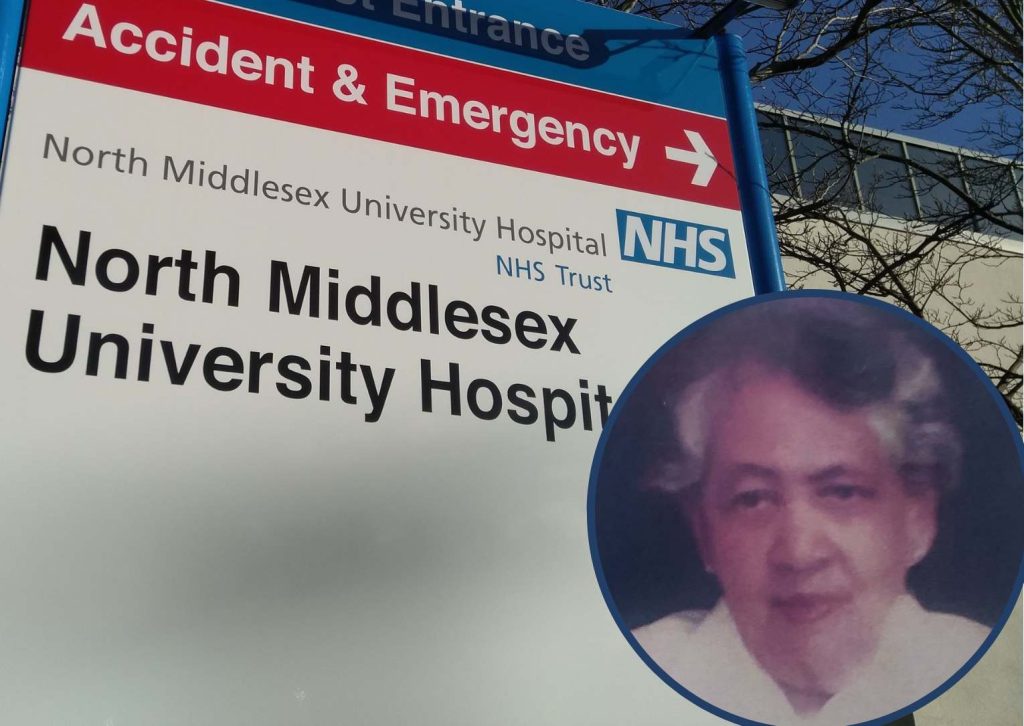
A couple have spoken of their anguish after their beloved aunt spent 15 hours waiting in a corridor for a ward bed at North Middlesex Hospital before her death.
Ratna Roy Choudhury, an 84-year-old retired civil servant form Wood Green, died from sepsis at the Edmonton hospital’s A&E on 27th February.
After leaving a note on a hospital information board drawing attention to Ratna’s death, the family spoke to the Dispatch about what happened. According to Augustine Selvakumar Paul, Ratna’s nephew, and his wife Nitya, their aunt was taken by an ambulance from Chase Farm Hospital to North Mid because of heart rate issues.
Over four hours, from around 4pm to 8pm on 26th February, they stayed by their aunt’s side. As they recollect, the place was full of people but there seemed to be only a few staff members. Nitya said: “Not everyone had a bed. Hospital staff were stressed like mad, the consultant said to us very clearly, ‘I think you should complain, this is not acceptable.’”
Nitya describes the ordeal Ratna went through: “It took nearly two hours to do some basic check up on her. She was in excruciating pain and wanted some pain killers and that never happened in front of us.”
At one point the family said they were even forced to clean up and wash Ratna themselves after she had soiled herself and there was no-one available to take care of it.
They left the hospital that evening hoping to see her the next day, but her condition worsened overnight and at around 7am, Augustine got the phone call saying that Ratna had died. She had still been waiting for a bed.
Nitya explained: “I deeply regret leaving her. In Hindu we have the last right of giving water and she asked me for water and for the spray, and I was so much into the spray that I forgot about the water. Later at two o’clock in the morning I woke up and said to my husband, ‘I forgot to give water to her’. I still regret why I left her in that corridor.
“[Leaving the note] was like saying ‘people died in this corridor in this particular spot’. If I had seen something like that me or my husband would definitely have stayed there.”
There had been a junior doctor’s strike on at the time of Ratna’s death and Augustine said: “Everyone below consultant is a junior doctor […] So the only person that can look after patients is a consultant who’s on duty. The nurses cannot administer painkillers until the consultant authorises it. So in the end you might wait for hours.”
Nitya continued: “Ambulances were queuing up outside with patients inside who were waiting to get into the corridor, but they cannot get into the corridor because people in the corridor haven’t got into the cubicle yet. So if you call an ambulance the reason why it is delayed is that they are all sitting outside the A&E waiting to release the patients.
“I presumed ambulances queuing outside happened only during Covid time, but now this has become a normality.”
As the hospital seemed so short of staff, basic care like helping people to the bathroom or cleaning them was often being delivered by family members, Nitya says. “Even to check the temperature I literally had to chase them in a sense not that they were not doing anything.
“They had so many things to do and so many people to look after. So many people pulling them and so many things to follow. And also the system was slow as well. There were so many layers of doing even the smallest things.”
While still very upset about how their aunt passed away, Augustine and Nitya say they do not hold anyone responsible for Ratna’s death, as it was unlikely she could have been saved.
But Augustine has criticised the system in place to cover the junior doctor’s strike. He says: “When they go on strike they should make sure there is enough cover for patients to be given care and life-saving treatment, which they can’t get because of the fact that one person is trying to do the job of ten people.”
The couple acknowledge that the problems they witnessed are not unique to North Mid, with hospitals across the NHS all suffering with long waiting times and bed shortages, although North Mid continues to be well below average.
The 95% four-hour target for A&E attendances is being missed by NHS England, which recorded 71% of patients being admitted, discharged or transferred within this time in February, the month Ratna died. North Mid’s figure for the same month was 62%.
In December, North Mid also recorded the ninth-longest ambulance waiting times in England, with the average wait outside the hospital being more than half-an-hour.
Within days of taking on his new job, Health Secretary Wes Streeting admitted the NHS was “broken”.
During weeks following Ratna’s death, Nitya would visit the hospital to light a candle and leave notes about her death in order to bring an awareness to other patients and their families. As time passes, the Selvakumars want to remember their aunty the way she was.
As Nitya put it: “Ratna was law abiding, paid all her taxes, worked for civil service. I really really liked her as a human being because what you saw from her, you got.
“We don’t have any extended family in this country. The only person we had was Ratna.”
North Middlesex University Hospital NHS Trust has not responded to a request for comment.
Local news needs your support
We are proud that we were at the forefront of reporting on the recent local elections. We can’t do this without the support of our readers.
Independent news outlets like ours – reporting for the community without rich backers – are under threat of closure, turning British towns into news deserts.
If our coverage has helped you understand our community a little bit better, please consider supporting us with a monthly, yearly or one-off donation.
ACT NOW!
Monthly direct debit


Annual direct debit

£5 per month supporters get a digital copy of each month’s paper before anyone else, £10 per month supporters get a digital copy of each month’s paper before anyone else and a print copy posted to them each month. £50 annual supporters get a digital copy of each month's paper before anyone else.

More information on supporting us monthly or yearly
More Information about donations






 Enjoying Enfield Dispatch? You can help support our not-for-profit newspaper and website from £5 per month.