

EV expert and Enfield resident Stephen Lloyd-Jones explains how residents can plug in and charge up locally
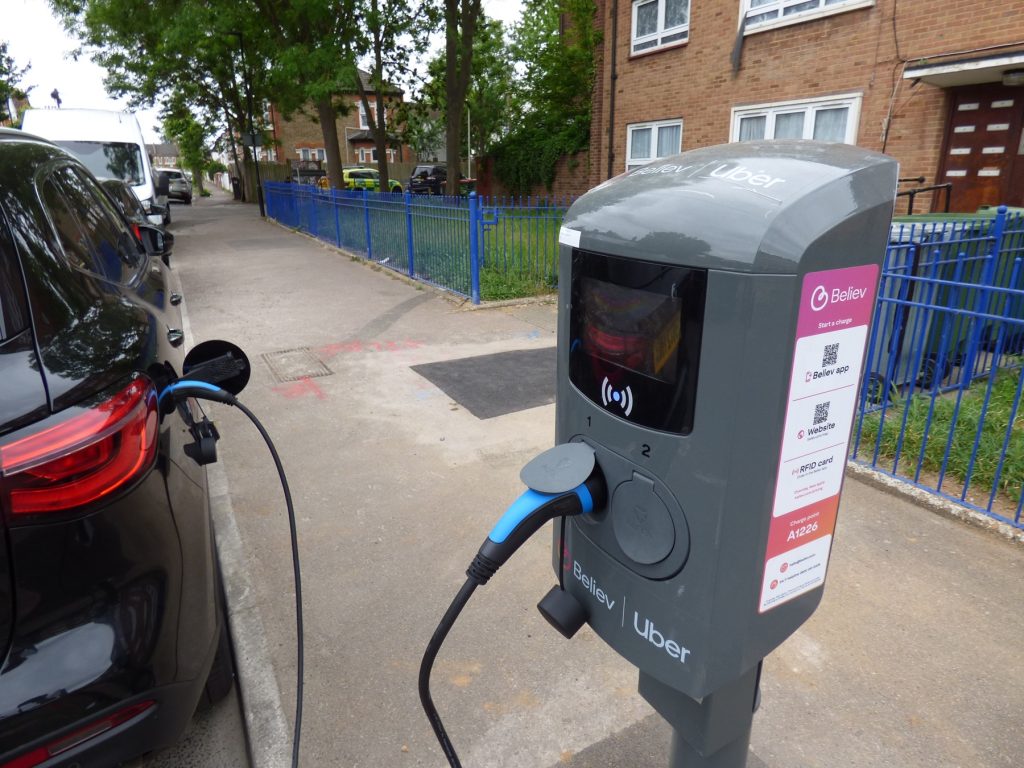
With petrol and diesel prices high and unpredictable, many people are looking afresh at electric vehicles (EV).
Large numbers of viable used EVs are reaching the market as leases end and depreciation reduces prices. These used vehicles are of the second or third generation and do not face historic issues such as major battery degradation.
Running cost savings include longer service intervals, cheaper ongoing maintenance and consumables, lower wear on brake pads due to ‘regenerative braking’, savings on tolls/congestion charge and even on car park or visitor permit charges.
But the key to really low EV running costs has historically been access to off-street parking to allow home charging.
Enfield residents living in flats or many terraced homes doing typical UK annual mileage of up to 8,000 per year should consider recent and future market developments.
Firstly, Enfield is relatively well provided with public chargers at a range of prices and locations. The go-to website/app is Zapmap where you can filter on price, speed and operator.
For slow neighbourhood charging including overnight, there are lamppost chargers from Ubitricity which have three tariff levels for night, standard and peak times (from 44p per kWh versus standard home tariffs of 25p-30p per kWh).
Enfield Council has mainly switched to Fuuse for its on-street bay and car park chargers – these are medium speed (7kWh or 22kWh) and cost 43p-54p per kWh.
Note that the EV’s spec and the charging cable dictate what speed they will achieve on 22kW chargers. For more urgent charges ahead of a longer trip, MFG Connect has 50kW chargers at 69p per kWh plus ultra-fast 300kW chargers at 79p.
Other local rapid chargers are at Shell stations and Lidl, and locations for BP Pulse, Zest and Leap24 (which has van-specific bays in Edmonton). Most of these are in the 75p-90p per kWh cost range and may be considered equivalent to expensive motorway service petrol stations.
Taking my older EV, which averages 170 miles of range in a local/regional radius, with a 38 kWh usable battery: a full 0-100% charge on a typical home tariff of 25p would equate to £9.50 or around 6p per mile and take around five hours to charge with a 7kW professionally-installed charger.
The best case night-time home tariff of 8p (eg Octopus) would be around 2.4p per mile; at Ubitricity’s 44p late night rate, around 9.5p per mile; at MFG 50kW at Morrisons, 14.5p per mile.
A comparable smaller car doing 40 miles per gallon at 150p per litre for petrol would be around 17p per mile, and more for diesel. If you only ever charged at the most expensive ultra-rapid chargers in Enfield, the cost per mile would still be very similar to the equivalent small petrol car, minus the other ongoing cost savings, plus the smooth, quiet ride of an EV and special features like remote cabin cooling in summer and frost-thawing pre-heating in winter.
A recent innovation for those with no off-street parking is ‘pavement channelling’, which allows residents in viable locations to safely charge their car kerbside at the best home rates. Enfield Council has contracted Kerbo Charge to start installing these, following a successful pilot.
Each location is considered based on local conditions and the resident would need to be confident they could regularly park within a couple of spaces distance a few times per week, which would be sufficient for most low-to-medium mileage drivers.
The resident does have to pay for a home 7kW charger and contribute towards pavement survey and installation costs, but further grants may become available from national funds. They may also need to buy a longer type two charging cable from a reputable retailer, and nobody should rely on domestic extension cables if charging from the car’s type two connector cable with a three-pin plug end.
Lastly, like any competitive technology market, regular tariff changes can happen. For example, rapid charge networks offering lower rates after 8pm, there can be summer offers in tourism hotspots, and special rates on newly-opened sites.
Some of these are dependent on using their app, but government regulation now means that all public rapid and ultra-rapid chargers must accept contactless payment. Multi-network payment (RFID) cards such as Electroverse and ChargePoint often make the process easier and may help avoid temporary holding charges on your bank card (using credit rather than debit card helps avoid those too).
So perhaps now is the time to switch to quieter, lower emission and lower cost vehicles in Enfield.
Local news needs your support
We are proud that we were at the forefront of reporting on the recent local elections. We can’t do this without the support of our readers.
Independent news outlets like ours – reporting for the community without rich backers – are under threat of closure, turning British towns into news deserts.
If our coverage has helped you understand our community a little bit better, please consider supporting us with a monthly, yearly or one-off donation.
ACT NOW!
Monthly direct debit


Annual direct debit

£5 per month supporters get a digital copy of each month’s paper before anyone else, £10 per month supporters get a digital copy of each month’s paper before anyone else and a print copy posted to them each month. £50 annual supporters get a digital copy of each month's paper before anyone else.

More information on supporting us monthly or yearly
More Information about donations






 Enjoying Enfield Dispatch? You can help support our not-for-profit newspaper and website from £5 per month.