

The government is currently considering whether or not to go ahead with a 21,000-home scheme at Crews Hill and Chase Park, reports James Cracknell
The government’s new towns programme will “fail to deliver thriving, sustainable communities” unless high-quality public transport is included from the outset, according to a new academic report.
The University of Hertfordshire report argues that low-density, car-dependent housing development leaves many residents with little choice but to drive, increasing congestion, carbon emissions and pressure on local infrastructure.
With the government committed to delivering 1.5 million new homes and considering a new generation of new towns, University of Hertfordshire researchers say there is a clear opportunity to avoid repeating those mistakes.
One of the seven shortlisted new town locations is Crews Hill and Chase Park in the rural north-west of Enfield borough. The government is due to make a decision on whether to go ahead with the proposed 21,000-home development on Metropolitan Green Belt land before the end of the year.
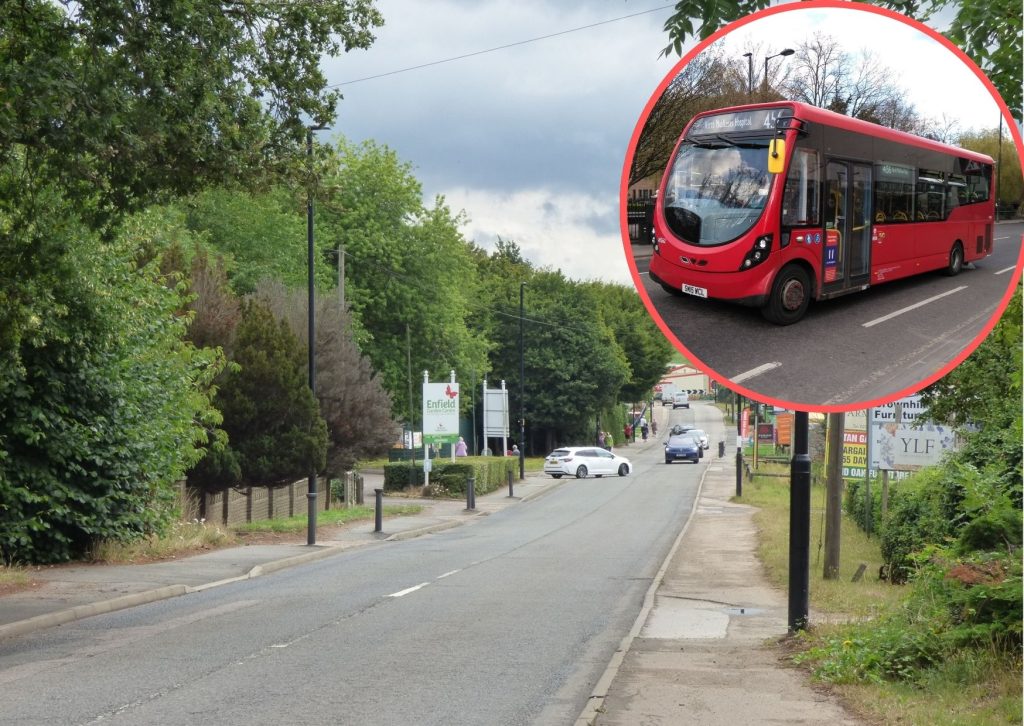
Crews Hill has a railway station, but is only served by two trains per hour during off-peak periods, while it also currently has just a single half-hourly bus service which does not connect to the station.
The area of farmland around World’s End dubbed ‘Chase Park’ has no railway stations. Two bus services, the 121 and 307, run through the area along Enfield Road, connecting to Oakwood Station in the west and Enfield Chase Station in the east.
Drawing on case studies from Freiburg in Germany, widely regarded as a world leader in sustainable urban development, as well as major developments in Cambridge and Harlow, the University of Hertfordshire report concludes that public transport, walking and cycling networks must be planned and funded before homes are built.
The report, Better Places: New Settlements with Transport that Works, comes from researchers at the University of Hertfordshire’s smart mobility unit, who are acknowledged experts in new towns.
Co-authors Stephen Joseph OBE and Sue Walsh say the UK must allow more homes of a higher quality inside a compact footprint, creating a more connected and active community, more space for parks and community facilities, and a reduction in cars, parking requirements, road congestion, and carbon emissions.
Stephen said: “Our report notes that much of the UK’s recent housing development has been of low density, with limited or no shops and community services, limited public transport and, sometimes, no pavements. This leads to car dependence with on and off-street parking issues and wider impacts on people’s health and independence.
“It has been shown in the UK that we can build at higher density with less car use, but high-quality public transport must be in place from the beginning and fully integrated with the master-planning of the developments.
“Germany solves this by using land value uplift and public funding to cover temporary transport subsidies for mass transit developments, but these funding routes are not really available in the UK at present.”
Achieving a higher density of housing is an important factor in the report. Housing densities are higher in Freiburg than in the UK – this is because housing in Freiburg is built around sustainable public transport ‘spines’, primarily using trams or linked bus routes. In turn this allows a more efficient approach to parking, streets that support cycling and walking, and reduced need for car ownership.
The report points out that Freiburg also has a governance and finance structure that allows for a “streamlined and joined-up approvals process and advance funding to be unlocked”, enabling transport connectivity to come first. Its financing model uses the uplift in land values from development – termed ‘land value capture’ – to provide upfront funding for public transport.
A similar approach was utilised in the UK to help finance the Elizabeth Line.
The report was compiled after extensive study visits together with officials and it also looks at new developments in Cambridge and Harlow.
The authors conclude: “Our visits – both to Freiburg and to Cambridge and Harlow in the UK – show that it is possible to deliver new housing without relying on and providing for high levels of car use.
“Simpler governance, clear planning systems, new funding and financing regimes (including devolved funding for public transport so that it can be provided in the early years), stronger masterplans and design codes and opportunities for community and resident involvement along the way, will all help deliver the vision in the New Towns Taskforce report”.
Enfield North MP Feryal Clark recently spoke out against elements of the new town proposed for Enfield, arguing in a piece for the Dispatch that Chase Park should be entirely removed from the plans.
This summer local campaigners also handed thousands of letters opposing the new town to 10 Downing Street.
The government’s housing minister Matthew Pennycook recently told a House of Lords committee that a decision on whether or not to go ahead with each of the seven shortlisted new town locations would be announced before the end of the year.
Read the full report:
Visit herts.ac.uk
Local news needs your support
We are proud that we were at the forefront of reporting on the recent local elections. We can’t do this without the support of our readers.
Independent news outlets like ours – reporting for the community without rich backers – are under threat of closure, turning British towns into news deserts.
If our coverage has helped you understand our community a little bit better, please consider supporting us with a monthly, yearly or one-off donation.
ACT NOW!
Monthly direct debit


Annual direct debit

£5 per month supporters get a digital copy of each month’s paper before anyone else, £10 per month supporters get a digital copy of each month’s paper before anyone else and a print copy posted to them each month. £50 annual supporters get a digital copy of each month's paper before anyone else.

More information on supporting us monthly or yearly
More Information about donations



 Enjoying Enfield Dispatch? You can help support our not-for-profit newspaper and website from £5 per month.