

Michael Rye told councillors he thought the “scandalous” move went directly against the devolution agenda the Labour government claims to be enacting, reports Joe Ives, Local Democracy Reporter
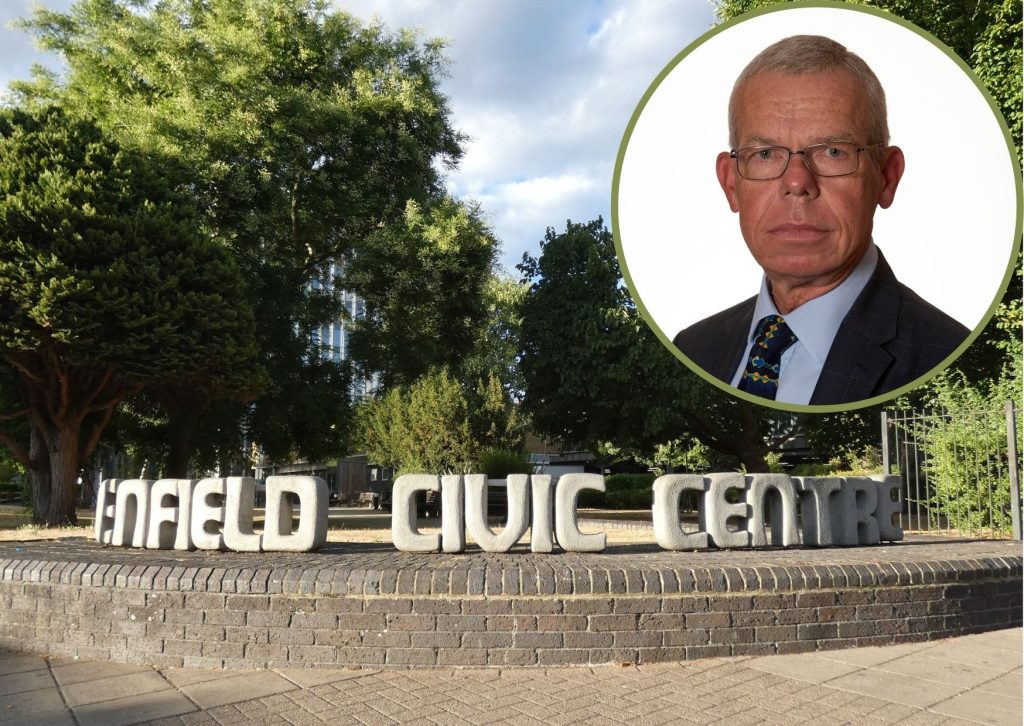
Enfield Council has been subject to “an unholy attack” after being forced to adopt a reduction to its planning powers, according to its deputy leader.
At a full council meeting yesterday (Wednesday 16th) the minority Conservative administration agreed to implement controversial changes to its constitution following nationwide changes imposed by the Labour government.
Councils are required to put new processes in place by the end of October following the passing of the Planning and Infrastructure Act 2025 and new town and country planning regulations formalised this year.
Deputy leader Michael Rye, when putting forward the constitutional amendments on Wednesday, resigned himself to “the disagreeable task of being an agent of the government”.
“I think this is an unholy attack upon local government, upon local democracy and upon residents,” said Cllr Rye.
He also claimed Westminster had shown it “doesn’t want to trust local democracy, it doesn’t want to trust members – and it wants to take over our planning committee and the planning committees up and down this land”.
The regulations set out a two-tier approach to planning, described as schedule one and two.
Schedule one applications “must always be delegated to officers”, the new law states. This is unless they are an “own interests” application, where an officer or councillor may be involved, directly or indirectly, in the outcome.
Schedule two applications, on the other hand, are only “presumed” to be delegated to officers. This will be the case unless a “nominated officer” and “nominated” councillor agree that it should be sent to the planning committee for determination.
Even here, applications will need to meet pre-set criteria, such as relating to “an economic, social, or environmental issue of significance to the local area” and/or a council’s local plan.
Here, the final decision “must be determined by officers” – not by elected members.
For Cllr Rye this fact represents a “scandalously” anti-democratic overhaul.
The new rules will also remove the ability of councillors to ‘call in’ applications for scrutiny by the local authority’s planning committee. This is a mechanism used when a member has concerns over an application that would otherwise be decided by unelected officers.
Cllr Rye described the loss of call-in powers as “very significant”. Referring to applications that have been improved by this process, he warned that the measure could also prove counterproductive “for everybody involved”.
Labour councillor Abdul Abdullahi, meanwhile, said that the main opposition group at Enfield Civic Centre supported the government-imposed changes “wholeheartedly”.
Cllr Abdullahi claimed the move “doesn’t mean losing democratic oversight”. Instead, he argued that it would help councillors by taking away their democratically-awarded burden of power over “routine” planning applications by putting them in the hands of “qualified planning officers”.
The changes, he argued, would help get “the balance right between democratic accountability and efficient decision-making processes”.
Cllr Rye, meanwhile, said the government was wrong to claim the changes would help fix a supposedly “clogged up” planning system.
He instead pointed to “huge sums of money borrowed during Covid” and “a sluggish economy” as the main reasons why the country was struggling to reach its housing targets.
Last month Liam Robinson, chair of the inclusive growth committee at the Local Government Association said that councils across the country “broadly support” the government’s changes.
Robinson, who also heads Labour-run Liverpool City Council, suggested that councils are “ready to support” Westminster’s aim of speeding up housing delivery.
Nevertheless, he also warned that “some concerns remain”, especially in regards to a new government-prescribed framework that will force a ‘default yes’ on certain types of developments, such as residential schemes “within reasonable walking distance of well-connected stations”.
Local news needs your support
We are proud that we were at the forefront of reporting on the recent local elections. We can’t do this without the support of our readers.
Independent news outlets like ours – reporting for the community without rich backers – are under threat of closure, turning British towns into news deserts.
If our coverage has helped you understand our community a little bit better, please consider supporting us with a monthly, yearly or one-off donation.
ACT NOW!
Monthly direct debit


Annual direct debit

£5 per month supporters get a digital copy of each month’s paper before anyone else, £10 per month supporters get a digital copy of each month’s paper before anyone else and a print copy posted to them each month. £50 annual supporters get a digital copy of each month's paper before anyone else.

More information on supporting us monthly or yearly
More Information about donations





 Enjoying Enfield Dispatch? You can help support our not-for-profit newspaper and website from £5 per month.