

The judicial review case went ahead despite Enfield Council choosing not to make any legal defence of its decision to award planning permission last year, reports James Cracknell
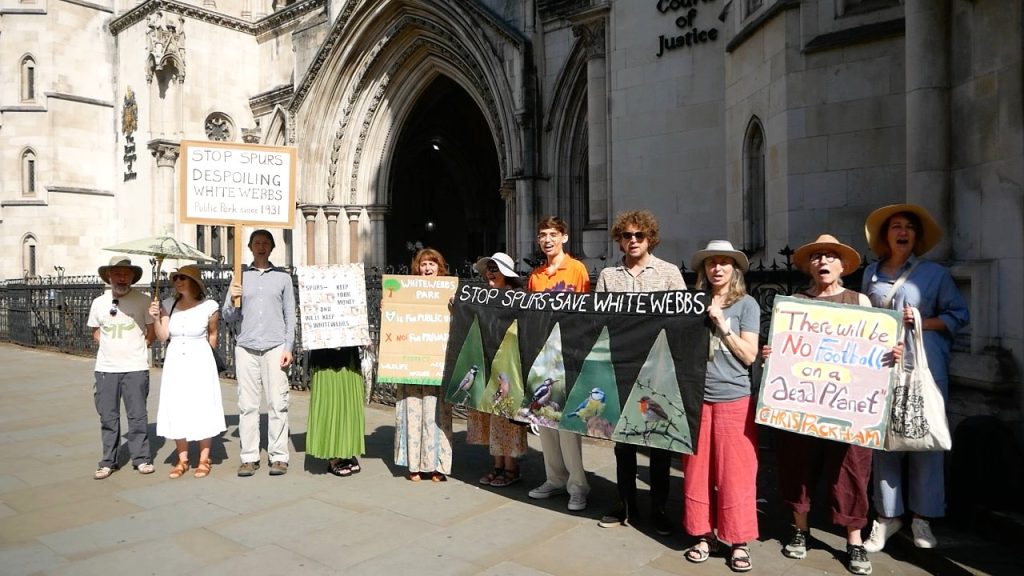
The fate of Tottenham Hotspur’s plans to build a training facility on Whitewebbs Park rests in the hands of a judge who spent two days at the High Court this week hearing legal arguments for and against the decision to approve the scheme.
In what was the second time in as many years that the future of Whitewebbs was debated at the High Court, on this occasion the judicial review case abnormally proceeded without any legal defence being put forward by Enfield Council, which had awarded the Premier League club planning permission for the women’s training centre last year.
That’s because the council recently underwent a political transition from the previous Labour leadership – which fully backed the controversial scheme proposed on the park’s former golf course – and the new minority Conservative administration which won election last month on a key pledge to “save Whitewebbs” from development.
Instead of the council’s legal defence, the court instead heard extensive arguments made by a barrister from Tottenham Hotspur Football Club (THFC) – with Spurs retaining the right to representation at the hearing thanks to having ‘interested party’ status.
The judicial review began with lawyers instructed by the Guardians of Whitewebbs campaign group putting forward their five ‘grounds’ for the case, essentially arguing that the decision to grant planning permission had been made unlawfully.
The first ground was the claim the council had failed to disclose to councillors the views of a professional ecologist who had raised “serious concerns” about the Whitewebbs Park plans, allegedly causing the planning committee to be “misled”.
The second and third grounds concerned alleged failures to represent or interpret the council’s own planning policies, while the fourth argued the civic centre “erred in its consideration of impacts on the openness of the Green Belt”.
The fifth and final ground for the case put forward by the claimant was the accusation the council had been “biased” in favour of THFC thanks to the hospitality and gifts given to key people at the council by the football club.
Written submissions from the Guardians of Whitewebbs legal team, led by Jenny Wigley KC, explained that Guardians of Whitewebbs campaigner Sam Tillbrook had used transparency laws to obtain council documents revealing that Giles Sutton – instructed to provide ecological advice for the council in respect of the planning application – had warned in November 2024 that estimates for biological net gain (BNG) made by THFC in its planning application resulted from an “incorrect” classification of the park’s woodland.
Sutton wrote: “In my opinion if the council were to accept this their decision could be easily challenged.”
However, Wigley argued that the council officers’ report prepared in advance of the planning committee meeting on 11th February 2025 – which ultimately resulted in the scheme being voted through by Labour councillors – failed to explain or even mention Sutton’s “serious concerns about [Tottenham Hotspur’s] BNG calculations, and the fact that the council’s own ecologist agreed with objectors on this key issue”.
Instead, the officer’s report stated there was “no objection” from the council’s ecologist, resulting in the planning committee being “materially misled by planning officers”.
“If objectors and committee members had known about the dispute between the council’s own ecology experts, plainly this could have made a difference to the outcome,” Wigley argued.
In response, THFC barrister James Maurici KC explained that there was “extra ecological work” conducted as a result of Sutton’s concerns and that he had ultimately been “satisfied” by the results, with Maurici noting in particular that a reptile survey had found “just a single record of a common lizard” on the site.
“There were strongly held professional views [by THFC] that there was no need to do these surveys,” Maurici told the court. “But in the end they were done, and Mr Sutton was satisfied.”
It was later pointed out by Alex Shattock, another barrister representing Guardians of Whitewebbs, that the common lizard is a protected species under UK law.
The second ground for the case saw the claimant argue that the council had “asked the wrong question” regarding one of its own policies, centred around the impact of the planning application on the local landscape.
“In effect, the officers’ report reversed the proper application [of the policy], from asking whether it would net improve the area of special character to asking whether it would not harm it.”
Maurici rejected this argument as “a classic case of excessive legalism” and that the “landscape character was considered very carefully in the officer report”.
He added that “the ultimate conclusion on landscape impact was that in ten years [the development] would actually be beneficial overall” thanks to “a huge number of positive aspects of these proposals, which were weighed up carefully by the committee members”.

The third ground for the judicial review claimed that the council’s planning report “failed properly to understand and/or apply” a policy that “requires refusal of any planning application that fails to conserve and enhance the special interest, significance or setting of a heritage asset”.
On this point the presiding judge in the case, Sir Timothy Kerr, noted that while the overall impact of the development was assessed by the council to be positive in broad terms, “the officers [in their report] make no bones about there being very high levels of harm to the park”.
Maurici countered: “I say the policy itself does not require a silo approach. The officers were entitled to take an overall view on heritage and overall it was positive. That is a legal judgement.”
The fourth ground for the claimant’s case concerned the council’s approach to considering the “openness of the Green Belt” on which the Guardians of Whitewebbs claimed the civic centre had “erred”.
They argued: “With the council accepting that the planning application entails the permanent loss of open space, it is difficult to understand how it could equally take the view that the replacement of open space with (largely) private football pitches and associated infrastructure would not impact on the openness of the Green Belt at all.”
Defending THFC on this point, Maurici explained to the court that “a lot of land in the Green Belt is privately owned” and that it was very common for there to be no public access to such land.
In this context, he argued, “openness is different from and not connected to whether there is public access or not”.
The fifth and final ground for the case – that “the fair-minded and informed observer would conclude that there was a real possibility the council in granting permission was biased” – was fiercely debated in the courtroom on the second day of the judicial review.
Guardians of Whitewebbs highlighted several examples of hospitality being offered and accepted by senior officers and councillors in the months immediately following the committee meeting which voted to grant permission for THFC’s Whitewebbs training centre.
This included the council’s chief executive Ian Davis and his interim successor Perry Scott meeting then-Spurs chairman Daniel Levy for a “working lunch” on 11th March 2025; Davis and a guest being gifted director’s box seats to a rugby match at Tottenham Hotspur Stadium on 22nd March; and then-council leader Ergin Erbil attending both a “charity legends” match on 23rd March and accepting a “VIP invitation” for the Europa League trophy parade on 15th May.
However, in defence of these gifts, Maurici pointed out that it was normal for a local authority to have a close working relationship with an organisation that already operated in the borough.
Arguing that THFC was “different to the ordinary developer” Maurici said: “The reason for that is the club’s activities spread into Enfield and that necessitates working with the council.
“They are one of the largest private sector employers in Enfield.”
Maurici also noted that “none of the offers of hospitality were made to members of the planning committee” nor to “officers charged with writing the [planning] report”.
However, after Maurici attempted to downplay the financial value of the hospitality gifts offered to Davis and Cllr Erbil, Mr Justice Kerr pointed out there was a “long waiting list” for season tickets at Spurs and that being invited to the director’s box was “difficult to monetise” because such an experience was unavailable to the general public.
Shattock added that where there was such a “close working relationship” between a council and a planning applicant “it calls for even clearer transparency”.
The claim of “bias” was also linked by the claimant to the decision not to include Sutton’s ecological advice in the council officers’ report, arguing that “the council appeared to be predisposed towards rejecting it”.
This was strongly refuted by Maurici.
In her final arguments at the end of the two-day case, Wigley hammered home the point about Sutton’s concerns being sidelined.
“We just simply don’t know – if they [the planning committee] had been given clear, firm and transparent information on the expert lack of consensus – how they would have weighed the balance.”
The judge’s written verdict on the case is not expected to be published for several weeks.
Two years ago, a judge who heard a separate judicial review case brought by Friends of Whitewebbs Park chair Sean Wilkinson against the council’s decision to award a 25-year lease to THFC eventually ruled in the council’s favour.
Local news needs your support
We are proud that we were at the forefront of reporting on the recent local elections. We can’t do this without the support of our readers.
Independent news outlets like ours – reporting for the community without rich backers – are under threat of closure, turning British towns into news deserts.
If our coverage has helped you understand our community a little bit better, please consider supporting us with a monthly, yearly or one-off donation.
ACT NOW!
Monthly direct debit


Annual direct debit

£5 per month supporters get a digital copy of each month’s paper before anyone else, £10 per month supporters get a digital copy of each month’s paper before anyone else and a print copy posted to them each month. £50 annual supporters get a digital copy of each month's paper before anyone else.

More information on supporting us monthly or yearly
More Information about donations




 Enjoying Enfield Dispatch? You can help support our not-for-profit newspaper and website from £5 per month.