

Humanists UK’s LGBT co-ordinator Nick Baldwin reacts to the new Enfield Conservative administration’s decision not to fly a Pride flag at the civic this year
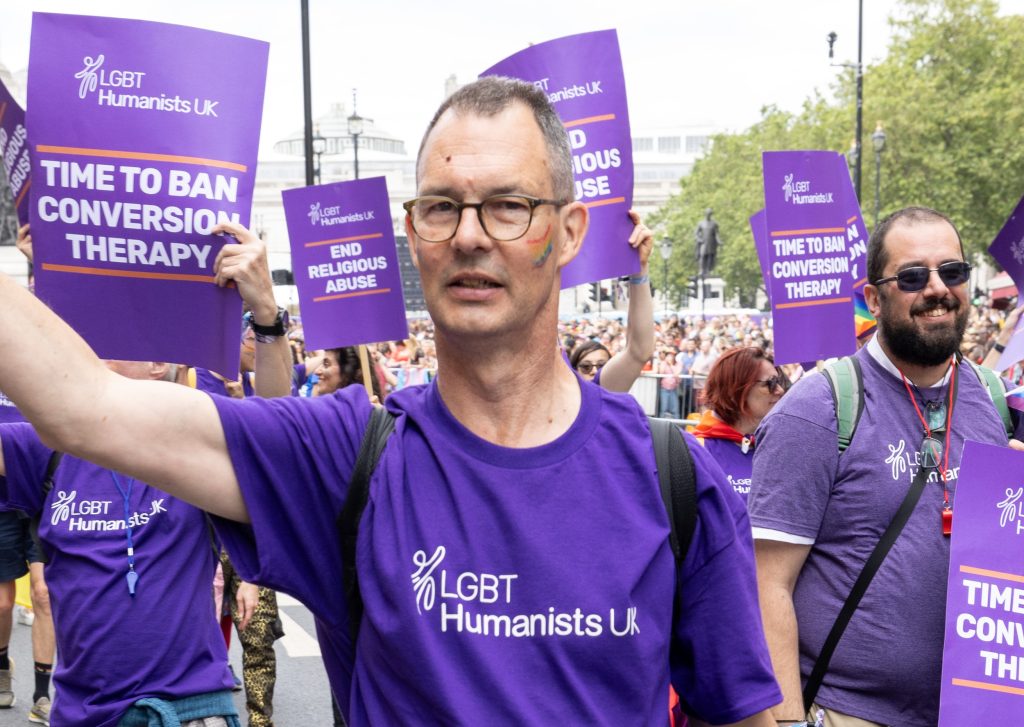
For years, every June, the Pride flag flew outside Enfield Civic Centre. This June, it didn’t.
The borough’s new Conservative administration has adopted a policy of flying only the Union Flag, the St George’s Cross, and the Enfield Beast flag. It did make an exception for Armed Forces Day at the end of June – but not for Pride.
I grew up in Enfield and attended school across the road from the civic centre, so this decision hit me surprisingly hard. But I’m well aware that Enfield is only the latest council to do something like this.
In June, Reform UK-run Havering cancelled its annual Pride flag-raising ceremony, days before it was due to take place. In Derbyshire, Reform councillors banned Pride flags following a complaint from a Christian bookshop owner. In St Helens, the council’s new Reform leadership ordered officers to cease all engagement with the town’s Pride celebrations.
Now the bans have spread beyond Reform-run councils to a Conservative one, in Enfield, a decision they said was made for “clarity”, “consistency” and to prioritise flags that “represent everyone”.
I won’t spend long on that final justification because it doesn’t merit it. A council that flies a special flag for the armed forces, as Enfield rightly did, has already accepted that recognising one community takes nothing from any other.
The neutrality argument is a paper-thin pretence, and everyone on both sides of the debate knows it. What is actually happening is that visible support for LGBT+ people is being deliberately withdrawn, dressed up in the language of flagpoles and planning consent.
Why does a flag matter so much? Because of the world it flies in.
Even excluding London’s Metropolitan Police (whose figures could not be counted this year), Home Office statistics recorded 18,702 hate crimes against people because of their sexual orientation in England and Wales in the year to March 2025, and 3,809 against trans people.
Despite modest falls in the last two years, those figures remain roughly 20% higher (for lesbian, gay, and bi people) and 50% higher (for trans people) than five years ago, with the sharpest surge coming in 2021/22 – a rise the Home Office said may have been fuelled by online debate about transgender issues.
Galop, the LGBT+ anti-abuse charity, saw a 60% increase in hate crime victims and survivors coming to it for support between 2023 and 2024. This is what years of escalating homophobic and transphobic commentary online looks like when it arrives in the real world: a shove on the night bus, a slur outside the school gates, a brick through a window.
And it is not only statistics. Last October, a Christian nationalist group calling itself the ‘King’s Army’ marched in military formation through Soho, the heart of London’s LGBT+ community, chanting at passers-by in a deliberate display of intimidation.
Humanists UK has been raising the alarm about rising Christian nationalism funded by US anti-human rights groups for some time. Religious groups with deep pockets, buoyed by cultural and political ascendancy in the United States, have deliberately exported a Maga-style politics, grounded in an extreme form of Christian theology, which is explicit about wanting to roll back LGBT+ rights, women’s reproductive freedoms, and other hard-won changes secured by progressive campaigners and humanists in the 20th and 21st centuries.
Recently, the movement has also found willing amplifiers in British public life, including a handful of MPs and home-grown billionaires.
Seen against that backdrop, Pride bans stop looking like quirks of local politics and start looking like part of a wider effort to push LGBT+ people back to the margins.
For decades, the UK built a broad consensus, across the major parties, most religious groups, and the overwhelming majority of non-religious people, that LGBT+ people are equal citizens whose inclusion is a basic British civic value, not a contested opinion.
What some cultural conservatives are now attempting is to unpick that consensus: to recast Pride not as a civic norm but as a ‘political’ or ‘ideological’ position, something a council may reasonably decline to be associated with.
First, the flag becomes ‘divisive’. Then it becomes comparable to the vilest things imaginable. We have seen where this road goes in other countries, recently including Poland, where dozens of local authorities declared themselves ‘LGBT-free zones’ until the EU intervened.
We also remember, some of us personally, how things used to be in this country. Symbols matter. That is precisely why they are being targeted. A Pride flag on a town hall never housed anyone or fixed a pothole, but it told every LGBT+ resident that their council saw them as part of the community it serves.
This is not about any one party. LGBT+ people, like humanists, belong to every party and none, and councillors from across the political spectrum – including many conservatives – have defended these flags.
It is about a choice now facing every council in Britain: whether inclusion remains a shared civic value, or becomes another front in somebody else’s culture war.
Humanists UK is a national charity bringing non-religious people together to develop their own views and an understanding of the world around them. Its petition to stop councillors banning Pride can be signed online:
Visit humanists.uk/action/reform-banning-pride
Local news needs your support
We are proud that we were at the forefront of reporting on the recent local elections. We can’t do this without the support of our readers.
Independent news outlets like ours – reporting for the community without rich backers – are under threat of closure, turning British towns into news deserts.
If our coverage has helped you understand our community a little bit better, please consider supporting us with a monthly, yearly or one-off donation.
ACT NOW!
Monthly direct debit


Annual direct debit

£5 per month supporters get a digital copy of each month’s paper before anyone else, £10 per month supporters get a digital copy of each month’s paper before anyone else and a print copy posted to them each month. £50 annual supporters get a digital copy of each month's paper before anyone else.

More information on supporting us monthly or yearly
More Information about donations




 Enjoying Enfield Dispatch? You can help support our not-for-profit newspaper and website from £5 per month.