

Enfield resident Frankie Brady opens up about his difficult childhood and how he wants to help others who struggle to ‘fit in’
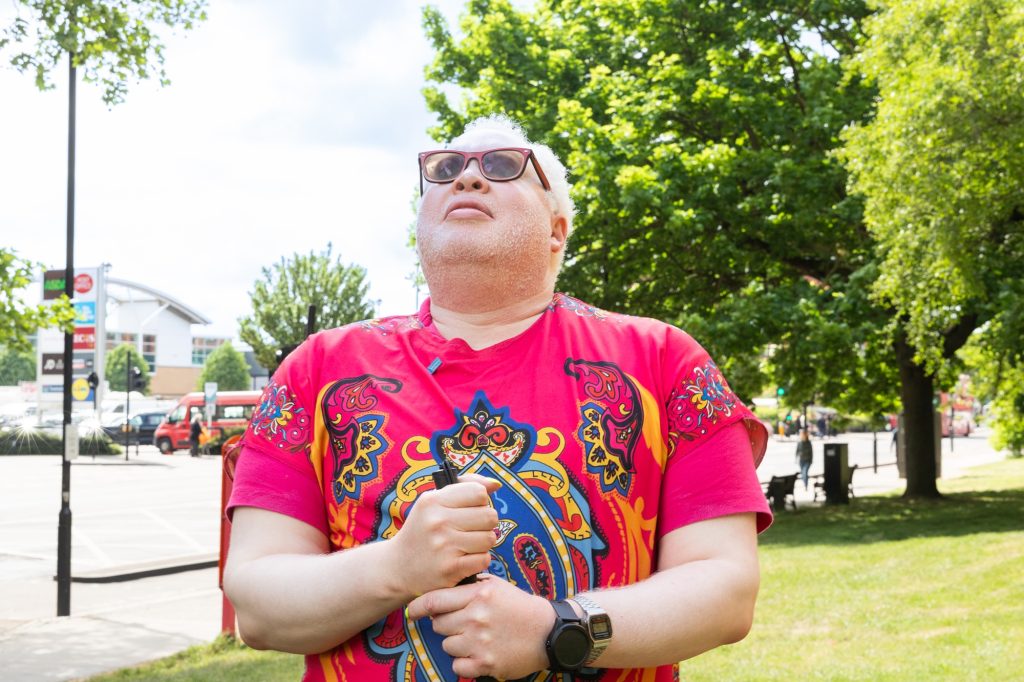
Who am I?
People say I am a genuine, honest and positive person. I’m a singer, songwriter, published poet and I’ve got a YouTube channel.
I love baking cakes, am a good dancer, and I have registered as a Zumba instructor. I volunteer at my gran’s care home and with The Alzheimer’s Society.
I am good at self-care, can reflect, and I try to make people feel good about themselves.
So that is who I am.
But my life hasn’t always been so positive. I struggled alone for a long time, and so I want to be honest now and share my story for other people in similar situations.
I always knew I was different from a young age. I have albinism – so I look white, yet my parents both come from the Caribbean.
My type of albinism means I lack melanin, a natural pigment for skin, hair and eye colour. My skin and eyes are light sensitive and I always have to wear glasses and a hat. I am registered as severely sight impaired.
My parents didn’t know much about albinism. I used to say to my parents: “I’m white but you’re black, why am I like this?”
Mum would say: “No, you are black.”
It was a lot for my mum to cope with, as people pointed and stared at me. Mum didn’t like to take me out without one of my aunts, because of all the abuse.
I was bullied a lot by kids at school and my whole life has been quite turbulent.
My dad did not want to be with me. Not only was I “too white” but I was also disabled.
My mum loved me and did the best she could, but she was facing her own challenges. I just wanted a positive role model to say to me: “You are great as you are.”
But I learnt very early on about rejection. It’s hard enough being rejected by society, but when your own father rejects you, that really hurts.
I had mobility training at school with a white cane to help with independence, but my dad said I couldn’t use the cane, as he couldn’t accept that I had a disability. This denial meant that I couldn’t ask for help, be angry or upset and express my feelings – so I became insular and alone.
Due to an unhappy childhood, by the time I was eight years old I became depressed. I didn’t go to college; I tried, but was bullied. Due to the many challenges that I was facing, I was self-harming.
Finally, I was diagnosed with post traumatic stress disorder (PTSD) in 2012 and obsessive compulsive disorder (OCD) in 2014 and have recently been referred for an autism diagnosis. I have experienced regular bouts of mental ill health and have been hospitalised.
But that’s not all!
As a small child, I knew I wasn’t like other boys. I liked playing with dolls; yet another way that I was different. I used to dress up in mum’s clothes in secret because my dad would never have approved.
As I grew up, I became suicidal as I was so ashamed, and it was only after a breakdown that I finally started to get the help I needed.
After years of therapy, I have to be honest. I came out in 2016 and decided I wanted to live as a woman even though some family members disapproved and would not accept me.
Being LGBTQIA+ is still a taboo among many of the older generation within the black community. My dad said: “Don’t bring shame upon our family.”
I respect my family, but I refuse to be ashamed any more and change who I am.
So who am I?
I have many different identities, but most importantly, I am a person just like you. We all have challenges, some more so than others, and you don’t know what someone else is going through.
Be compassionate – I would love to create a world where we can all just be ourselves.
So, what do I want?
Please don’t make assumptions; I may look different to you, but get to know me and others like me, before you judge. Some of my family still don’t accept me, but I don’t want your pity, I just want to be treated with dignity and respect. It’s taken a long time, but I have finally been able to embrace who I am.
Now my dream is to help anyone who is struggling to ‘fit in’ to get help. You’re not alone; don’t suffer in silence, you need to learn to love and embrace who you truly are and, when you do that, you will not be so affected by what other people think.
If I can offer even one person hope that they can overcome their challenges like me, then I know I’ve made a difference and paid it forward.
Frankie is part of Empowering Disability In Enfield (EDIE), a group supported by LocalMotion Enfield.
The Samaritans are available to help if you need someone. They are available to talk to for free:
Call 116 123
Visit samaritans.org
This article is published with support from LocalMotion Enfield, part of a UK-wide movement for community-led change

Local news needs your support
We are proud that we were at the forefront of reporting on the recent local elections. We can’t do this without the support of our readers.
Independent news outlets like ours – reporting for the community without rich backers – are under threat of closure, turning British towns into news deserts.
If our coverage has helped you understand our community a little bit better, please consider supporting us with a monthly, yearly or one-off donation.
ACT NOW!
Monthly direct debit


Annual direct debit

£5 per month supporters get a digital copy of each month’s paper before anyone else, £10 per month supporters get a digital copy of each month’s paper before anyone else and a print copy posted to them each month. £50 annual supporters get a digital copy of each month's paper before anyone else.

More information on supporting us monthly or yearly
More Information about donations


 Enjoying Enfield Dispatch? You can help support our not-for-profit newspaper and website from £5 per month.